|
I would like to know the
evolution of an otter. What other species are they related to? Who did
they originate from? Who were there ancestors?
Sea otters are the most
recently evolved marine mammal. It is believed that they originated from
river otter stock or ancestors approximately 5-7 million years ago. Sea
otters are in the weasel or mustelid family. Other members of that
family include badgers, polecats, skunks, wolverines, martens, weasels,
fishers, sables, and river otters.
Can you please give me some
reasons why Southern sea otters need to be protected?
Sea otters are what biologists
refer to as a keystone species as well as an indicator species. Keystone
species have a disproportionately large effect on their ecosystem. For
example, when sea otters were almost exterminated by the fur trade, a
shift in the ecosystem took place. In the absence of sea otters, the
invertebrate kelp grazers they feed on, such as sea urchins,
proliferated and destroyed the kelp forests. When sea otters were almost
gone, so were the kelp forests. A indicator species is monitored by
scientists to get a general indication of the health of the ecosystem in
which it lives. When an indicator species population is doing well, that
is a sign that the ecosystem is healthy. Southern sea otters began dying
in 1995 from a disease that was associated with the prey they eat. This
tells us that we better pay attention to what is happening to sea
otters. If they're dying from disease associated with what they are
eating, and humans eat many of the same items, we need to watch for
similar health problems in people.
Sea Otters are my favorite
animal, can you tell me what I can do to help them and learn more about
them?
For more information about sea
otters, please visit:
www.defenders.org/defenders/kidsplanet/factsheets/otter.html
www.kidsplanet.org/tt/seaotter/home.html
www.defenders.org/wildlife/new/seaotters.html
In general, sea otter
populations are not doing that well in California (disease, entrapment
in fisheries gear, habitat degradation, food limitations) and Alaska (orca,
or killer whale, predation-- possibly other reasons such as pollution
are responsible).
Sea otters need help from as
many people as possible! Keep posted and inform others about the plight
of sea otters worldwide . Write letters to your congressional
representatives telling them how much you care about sea otters, how
important they are for the ocean and that you'd like to see efforts move
forward to recover declining sea otter populations. You could organize a
sea otter festival at your school too.
How is the California sea otter
different than the Alaska sea otter?
The California sea otter, or
southern sea otter, and the Alaskan sea otter, or northern sea otter,
are genetically distinct subspecies. Besides this genetic difference
there are some behavioral and physical differences. The Alaskan sea
otter can be slightly larger than California sea otters. The Alaskan sea
otters eat more fish and haul out on land more often than do the
California sea otters. And, finally, it has been observed that raft
sizes in Alaska can sometimes include hundreds of animals. In
California, these raft sizes are considerably smaller.
How do sea otters protect
themselves? What are their predators?
Sea otters have three basic
ways to escape predators: fleeing; taking refuge in the kelp where they
live; and coming up on land. They also have strong teeth they can use in
interactions with other sea otters. Great white sharks are the primary
predator in California. Studies in Alaska recently showed that orcas
(killer whales) are eating more and more sea otters in that region,
possibly because the usual prey (seals and sea lions) are in decline.
Other factors that may be influencing the orcas to eat more sea otters
may include natural disturbances to the ecosystem that occur over space
and time, as well as overfishing. Other reported predators that feed on
sea otters include stellar sea lions, coyotes, bears and eagles.
Where do sea otters
give birth?
On land or in water for the southern, or California, sea otter.
How do sea otters give birth?
Like all mammals, they give birth to live young. Otter babies are called
pups.
When do sea otters give birth and how many pups are born?
Sea otters generally give birth to one pup a year. If they give
birth to two, they will abandon one of them, as they can't care for two
at a time. This is how pups are orphaned. Orphans rescued by trained
wildlife rehabilitators can survive to adulthood and, in fact, all three
otters at the Monterey Bay Aquarium were orphans. Otters are full-grown
at about 3 years of age and generally they are weaned between 6 months
and 1 year of age.
How big are pups when they are born?
3-5 lbs.
How do they grow?
Through drinking the very fat, rich milk that the mother provides for
the first two months of the pups’ life. Solid food is gradually worked
into the pups’ diet as they mature.
How do sea otters communicate?
Through body contact, nosing one another, head-jerking and
vocalizations. Sea otters, in comparison to sea lions, for example, are
not extremely vocal animals. However, adults use a soft, low cooing
sound, and grunts to exhibit "contentedness," among other
things. Pups use a high-pitch squeal to communicate with their mom. Some
other sounds in the vocal repertoire of sea otters include whistles,
whimpers, squeaks, whines, growls, snarls and hisses.
How are sea otters listed under the Endangered Species Act?
The southern sea otter is listed as "threatened." If the
population decline continues, this listing could be changed to
"endangered." The northern sea otter, which consists of
sub-populations in Alaska, Canada and Washington, isn’t listed as a
whole subspecies. The different sub-populations have different status
classifications. Currently there is no federal or state Endangered
Species Act listing for Alaska and Canada. There are petitions and
threatened lawsuits to force U.S. Fish and Wildlife Service to list
certain otter populations in the central Aleutian chain in Alaska.
Washington has listed the sea otter as endangered.
What other protections are afforded to sea otters?
All sea otters are classified as "depleted" under the federal
Marine Mammal Protection Act. The California sea otter is also listed
under state law as a "fully protected mammal."
What do sea otters eat?
Abalone, squid, snails and other molluscs; clams; mussels; crabs;
lobster; urchins; sea stars; sea cucumbers; chitons; marine worms; and
about 40 other marine invertebrates; and on occasion, marine birds; and
in Alaska, certain fish.

How do sea otters forage for food?
Sea otters generally do not spend more than two or three minutes
diving for food. They use their sensitive paws, whiskers and vision to
make their way through the water to find food. Sea otters then return to
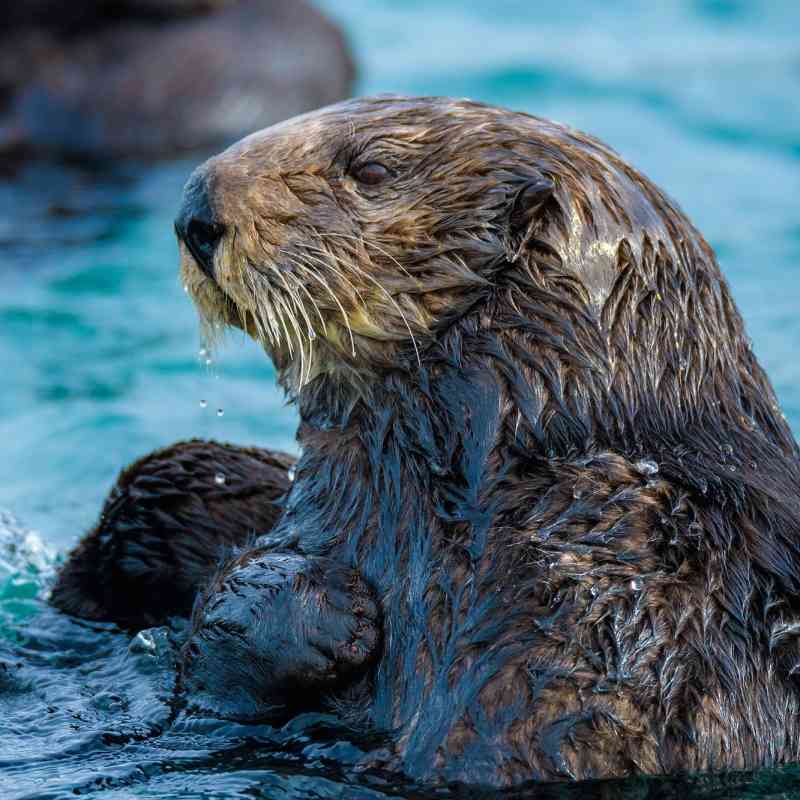
the surface with their prey, lie on their backs, place the food on their
chests and break open the prey using a tool of some kind (rock, bottle,
etc.).
Where are sea otters on the food chain?
Sea otters are considered to be "opportunistic feeders"
– that is, they feed on many prey items. They are carnivores, and, at
times, omnivorous, meaning they feed on both animal and plant food. They
are the top-end predator in the nearshore marine ecosystem.
What are the natural predators of sea otters?
Great white sharks are the primary predator in California. Ongoing
studies in Alaska recently revealed that orcas (killer whales) are
eating more and more sea otters in that region, possibly because the
usual prey (seals and sea lions) are in decline. Other factors that may
be influencing the orcas to eat more sea otters may include natural
disturbances to the ecosystem that occur over space and time, as well as
overfishing. Other reported predators that feed on sea otters include
stellar sea lions, coyotes, bears and eagles.
How do sea otters protect themselves?
Sea otters have three basic ways to escape predators:
fleeing; taking refuge in the kelp where they live; and coming up on
land. They also have strong teeth they can use in interactions with
other sea otters.
What is the lifespan of a sea otter?
Sea otter males generally live up to 10-15 years, while females live
15-20 years.
What is the habitat of a sea otter?
Sea otters live in the nearshore marine ecosystem, which consists of
rocky shores and kelp forests. In California, many sea otters spend a
considerable amount of time in an estuary called Elkhorn Slough that is
located near Moss Landing. A large part of their day is spent in the
kelp forest and rocky areas, where much of their prey is found. And, the
kelp canopy provides shelter and protection for sea otters from storms
and predators.
Do sea otters have personalities, specifically with their
interactions with humans?
Sea otters are wild animals, which means their behavior towards
humans can be unpredictable. Like people and other animals, they all
have individual personalities. Some may be aggressive towards humans and
other otters may be friendly. There have been occasional reports of sea
otters messing around with divers (e.g., pulling at their dive caps and
other things).
How do sea otters use their forepaws and forelegs?
Sea otter forepaws are quite dexterous and sensitive, allowing sea
otters to extract their prey from tight spots and to sense the prey they
do handle. The pads of their paws are different from those of dogs --
sea otters have a continuous pad that covers the whole bottom part of
the paw, while a dog’s paw is not fused.
What is the size and weight of sea otters?
California sea otters average 4 feet in length and 50-60 pounds in
weight. Northern sea otters are slightly larger.
What information do we know about the sea otter fur trade?
Aboriginal people hunted sea otters for many thousands of years. Coastal
North American Indians, northern Aleuts and the Japanese valued otters
for their warm fur. In some areas, the Aleuts over-exploited otters and
substantially reduced their populations. However, it wasn't until the
mid-1700s that widespread commercial hunting of sea otters took place,
leading to the near-extinction of the species. The extremely profitable
sea otter fur trade began in 1741, when a shipwrecked Russian expedition
led by Vitus Bering discovered sea otters on one of the Commander
Islands. ("Sea Otters" by Marianne Riedmann, 1997, published
by the Monterey Bay Aquarium). You can obtain more information about the
fur trade from this book.
What is the range of the California Sea Otter?
The California sea otter is found from Half Moon Bay in the north to, as
of 1998, just beyond Point Conception (in Santa Barbara county) in the
south.
What is the classification for sea otters?
- Kingdom-Animalia
- Phylum
-Chordata
- Subphylum
-Vertebrata
- Class
-Mammalia
- Order-
Carnivora
- Family-
Mustelidae
- Genus-
Enhydra
- Specific Epithet-
lutris
- Species -
Enhydra lutris
|